8 min read · Published: August 29, 2023 · Updated: October 29, 2026 · Prices and details checked: October 2026
Two full days are enough to see the core of Milan: the Duomo and its rooftop, the Galleria, Sforza Castle, Leonardo’s Last Supper, Brera and an evening along the Navigli canals. A third day gives you the fashion district at a slower pace or a train trip to Lake Como. Below: what is worth your time, what needs booking ahead and how to get around cheaply.
Key takeaways
- The Duomo rooftop and the Last Supper (Cenacolo Vinciano) are the two sights you must book ahead; Last Supper tickets are released quarter by quarter and the popular slots go within days.
- The historic centre is compact: Duomo, Galleria Vittorio Emanuele II, La Scala and the Quadrilatero della Moda are all within easy walking distance of each other.
- Metro lines M1 to M5 plus trams cover everything a visitor needs; a single ATM ticket costs 2.20 EUR and is valid for 90 minutes including changes.
- Milan Fashion Week runs twice a year, in late winter and again in early autumn; shows are invite-only, but hotel prices rise city-wide in those weeks.
- Lake Como (a short regional train ride) and Verona (a quick trip by high-speed train) are realistic day trips.
Table of contents
Which sights in Milan are actually worth the queue?
Four places justify a fixed slot in your itinerary: the Duomo rooftop, the Galleria Vittorio Emanuele II, Sforza Castle and the Last Supper. Everything else can be fitted around them.

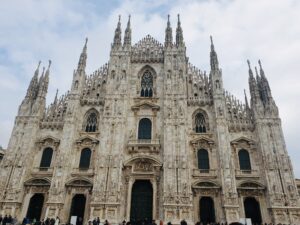
The Duomo di Milano is the largest church in Italy and took almost six centuries to finish, from 1386 into the 1960s. The highlight is the rooftop: you walk between the spires at eye level with the statues and see the Alps on a clear day. Buy a combined cathedral and rooftop ticket online on the official site (duomomilano.it), where you choose between stairs and lift; the ticketed entrance avoids most of the queue on the square.

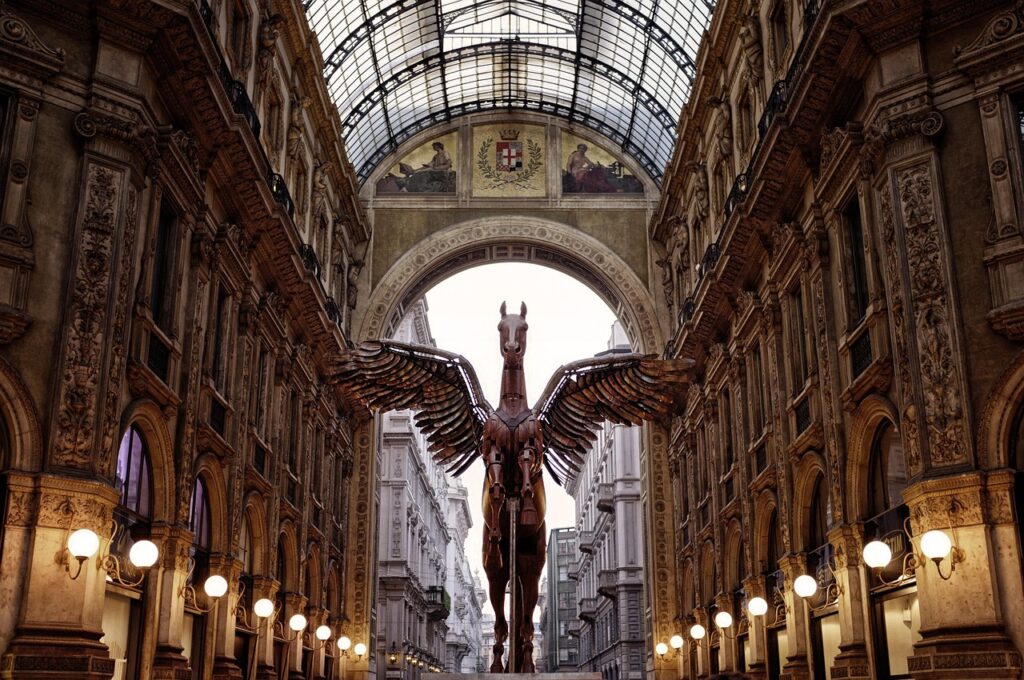
The Galleria Vittorio Emanuele II opens directly off Piazza del Duomo and leads through to Piazza della Scala. Walk through it for the glass dome and the mosaic floors, but have your coffee a few streets away. On the far side is Teatro alla Scala, whose museum lets you look into the auditorium from a box.
Sforza Castle (Castello Sforzesco) is a short walk from the Duomo along Via Dante. The courtyards are free; the museums hold Michelangelo’s unfinished Rondanini Pietà, his last work. Behind the castle is Parco Sempione, the easiest green space in the centre.
The Last Supper is in the refectory of Santa Maria delle Grazie, a short walk west of the castle. Visits last 15 minutes in groups of at most 40 people, and the refectory is closed on Mondays. Reservation is compulsory for every ticket: full price is 15.00 EUR, visitors aged 18 to 25 pay 2.00 EUR and under 18s enter free. Tickets are released on the official Cenacolo Vinciano site once a quarter for the following months and go quickly; if nothing is available, look for guided tours that include entry, because agencies hold allocations.
Where do you go in Milan for fashion, from couture to outlets?
The Quadrilatero della Moda (also called Quadrilatero d’Oro) is the fashion district proper: Via Montenapoleone, Via della Spiga, Via Manzoni and Via Sant’Andrea, just north-east of the Duomo. Prada, Armani, Versace, Gucci and Valentino all have flagship stores here.
You do not need to buy anything to find it worthwhile. For the design side of the story, Armani/Silos on Via Bergognone (Tortona district) shows four decades of Giorgio Armani’s work in a converted grain silo; the Fondazione Prada in Largo Isarco is the other big design-world address.
For independent labels and vintage rather than global brands, walk Brera north of the castle and Corso di Porta Ticinese towards the Navigli. Brera also holds the Pinacoteca di Brera, with Raphael, Caravaggio and Mantegna, and the small Orto Botanico behind it, free to enter.
Discounted designer stock means leaving the city: Serravalle Designer Outlet and Fidenza Village both lie outside Milan and are reached by shuttle bus or train. Check the current shuttle operators and departure points before you go, and allow at least half a day for either.
Find a hotel for your Italy trip
Flight plus hotel for all Italian regions, searchable by date and budget.
Show Italy offersWhat should you eat in Milan, and where?
Three dishes to try: risotto alla milanese (saffron risotto), ossobuco (braised veal shank, often served on the risotto) and cotoletta alla milanese (a thick, bone-in breaded veal cutlet). Panettone is the local Christmas cake and good bakeries sell it year round.
The cheapest way to eat well is the Milanese aperitivo. In the early evening, bars along the Navigli, in Brera and around Porta Venezia serve a drink with food included in the price; you pay a little more than for the drink alone and help yourself to the buffet or receive small plates. Treat it as a light dinner.
For a sit-down lunch, trattorias in the Navigli and Porta Romana areas are more reasonably priced than anything on Piazza del Duomo. Eataly on Piazza XXV Aprile (Porta Garibaldi) is the place to buy cheese, cured meat and wine to take home.
Which neighbourhoods show you Milan beyond the centre?
Navigli and Porta Nuova each show you a different side of the city in under half a day, and both are on the metro.
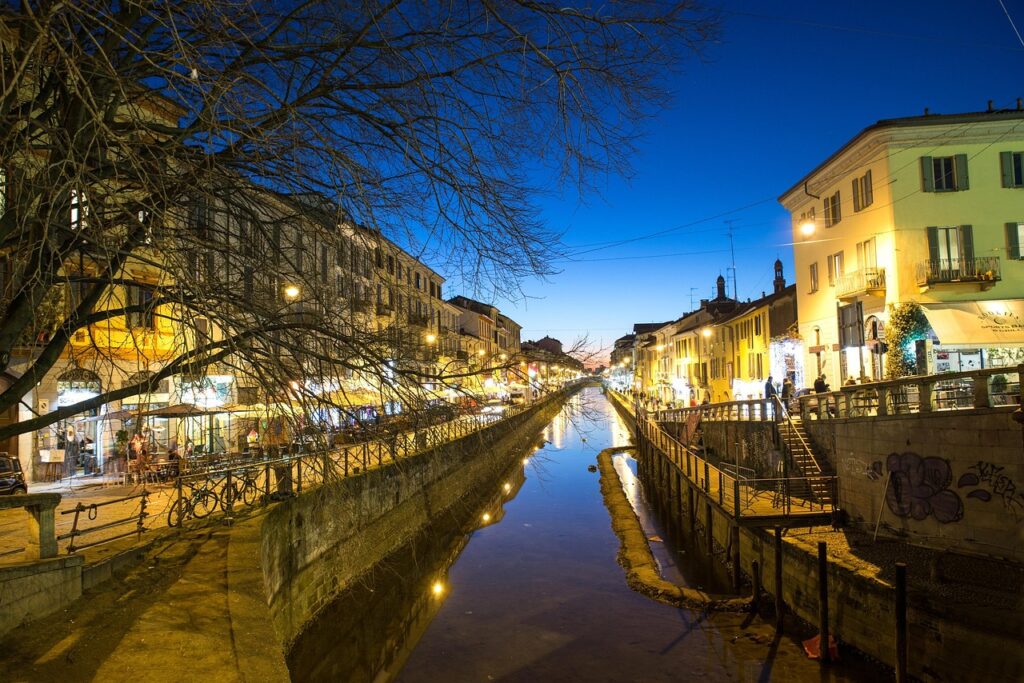
The Navigli are the two remaining canals of Milan’s medieval waterway system. Naviglio Grande, from the Porta Genova metro stop (M2), is lined with bars, small galleries and vintage shops; go towards sunset when the terraces fill. Once a month an antiques market stretches along the canal; check the current dates locally before planning around it. The Basilica di Sant’Eustorgio, a few minutes away on Corso di Porta Ticinese, keeps the Portinari Chapel, one of the best Renaissance interiors in Milan.
Porta Nuova, around Garibaldi station, is the new business district: the Unicredit tower by César Pelli, Piazza Gae Aulenti and Stefano Boeri’s Bosco Verticale, two residential towers planted with hundreds of trees. It is a few metro stops north of the centre on M2.
How do you get around Milan and from the airports?
Use the metro and trams and skip taxis in the centre. Milan has five metro lines (M1 to M5) run by ATM, and all the sights above sit within the central fare zone.
A single ticket costs 2.20 EUR and is valid for 90 minutes on metro, tram and bus, including changes. A 24 hour ticket costs 7.60 EUR, a three day ticket 15.50 EUR and a carnet of ten rides 19.50 EUR. You can also tap a contactless bank card or smartphone at the metro gates: ATM charges the cheapest applicable fare automatically, and from the fourth ride of the day you pay the daily ticket price. Check the official ATM site (atm.it) for fares, and validate paper tickets on trams and buses; inspectors are frequent.
From the airports: the Malpensa Express train runs every 30 minutes on each of its two lines and takes 51 minutes to Milano Centrale or 37 minutes to Milano Cadorna, for 15.00 EUR one way (25.00 EUR return when bought online); the Malpensa Shuttle coach to Centrale is the cheaper option at 10.00 EUR one way. Linate is on metro line M4, a short ride to San Babila in the centre. Bergamo Orio al Serio, used by low-cost airlines, is connected to Centrale by coach. We advise against a hire car: the centre is a congestion charge zone (Area C) on weekdays and parking is scarce and expensive.
When is the best time to visit Milan?
April to June and September to October give you the mildest weather and the most going on. July and August are hot and humid, and many family-run places close for part of August. Winter is grey and often foggy, but museums are empty and hotels cheaper.
Two events change the picture. Milan Fashion Week takes place in late winter and again in early autumn; Salone del Mobile, the design fair in spring, fills hotels across the whole city and pushes prices up even more. Check the exact dates for your year of travel: if you only want to sightsee, avoid both weeks or book accommodation months ahead.
FAQ
How many days do you need in Milan?
Two full days: day one for the Duomo, Galleria, La Scala and the fashion district, day two for the castle, Last Supper, Brera and the Navigli in the evening. Add a third day for Porta Nuova and a museum, or for a day trip.
Is Milan expensive compared to other Italian cities?
Hotels and restaurants in the centre cost more than in Rome or Florence, and much more during Fashion Week and Salone del Mobile. Public transport, museum entry and the aperitivo keep daily costs manageable if you sleep and eat outside the Duomo area.
Can you visit Milan Fashion Week as a tourist?
The runway shows are invitation-only for industry and press, so you cannot buy a ticket. During the week there are open exhibitions, brand events and installations around the Quadrilatero and the Tortona district. Book your hotel early if you plan to come then.
Is the Milan Duomo rooftop worth it?
Yes, it is the best view in the city and the closest you get to the Gothic stonework. Choose the stairs if you are reasonably fit, as the queue is often shorter. Go early in the morning or in the last hour before closing for fewer people.
What are the best day trips from Milan?
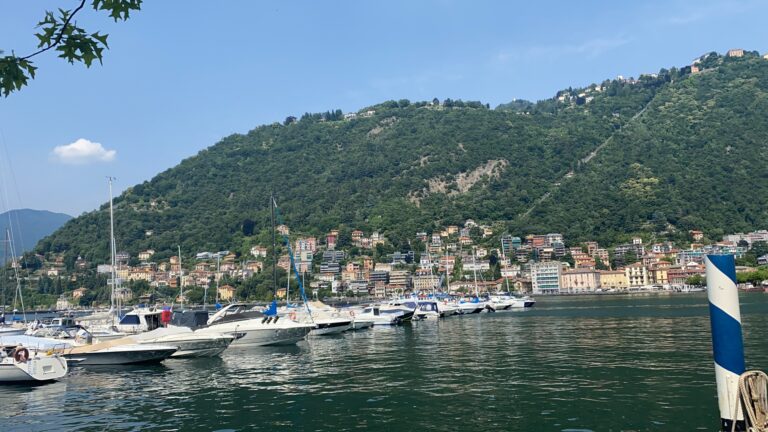
Lake Como is the easiest: regional trains from Milano Centrale reach Como San Giovanni in well under an hour, and from Como Nord Lago you can take the boat along the lake. Verona is a quick trip by Frecciarossa or Italo high-speed train. Both work without a car; see our guides to Como on Lake Como and Verona.
Book the Duomo rooftop and the Last Supper first and build the rest of your days around them; everything else in Milan can be decided on the spot. If you would like us to arrange flights, trains and hotels for Milan or the lakes, see our travel booking service.
Image credits: Pixabay / IgorSaveliev; Pixabay / pippocucu
 Seychelles with Kids: Beaches, Reserves and Turtles
 A Week on a Yacht: Daily Life, Space, Seasickness and Cost
 Yacht Charter in Malta: What to Know Before You Book
 How to Behave at a Maltese Festa: A Visitor’s Guide