8 min read · Published: August 28, 2023 · Updated: October 29, 2026 · Prices and details checked: October 2026
Two days are enough to see Verona’s main sights without rushing. The old town is compact and almost entirely walkable, so a weekend splits neatly into a Roman and market-square day and a castle, bridge and river day, with an aperitivo to close each one.

Key takeaways
- Arrive by train at Verona Porta Nuova, the main station on the southern edge of the centre. From there you walk or take a city bus into the old town.
- Day one covers the Roman Arena, Piazza delle Erbe and the Torre dei Lamberti. Day two covers Castelvecchio, the Ponte Scaligero, Ponte Pietra and the hillside above it.
- Juliet’s balcony is a fictional landmark. It is worth a short look on the way, not a reason to plan your day around it.
- The 2027 opera season in the Arena is scheduled from 12 June to 11 September, with tickets from 22 EUR for a numbered seat on the steps.
- The city bus costs 1.50 EUR for a 90 minute ticket and 5.00 EUR for a 24 hour ticket. You will rarely need it inside the centre.
Table of contents
- How do you get to Verona and around once you are there?
- What should you see on the first day?
- Is Juliet’s balcony worth visiting?
- What should you do on the second day?
- Where do you go for aperitivo and a local meal?
- When is the best time to visit, and what about the opera season?
- FAQ
- Plan your Verona weekend
How do you get to Verona and around once you are there?
The easiest way is the train. Verona sits on the main line between Milan and Venice, and Porta Nuova station is the arrival point for most regional and fast services. We could not confirm current journey times from Milan, so check the timetable on Trenitalia before you book. If you start in Milan, our Milan guide helps you decide how much time to give that city first.
Porta Nuova is outside the historic centre. You can walk into town or take a city bus. Verona’s operator ATV sells a single ticket for 1.50 EUR, valid for 90 minutes. Buying on board costs 2.00 EUR and covers one trip only. A 24 hour ticket costs 5.00 EUR.
Inside the old town you will not need transport at all. Distances between the main sights are short, the streets are partly pedestrianised, and a car is a burden because of restricted traffic zones. If you arrive by car, park outside the centre and walk in.
If you plan to enter several paid sights, the VeronaCard is worth pricing out. It costs 33 EUR for 24 hours and 38 EUR for 48 hours, is valid for a year from purchase, and does not include the Aerobus airport shuttle. It only pays off if you visit several paid sights.
What should you see on the first day?
Start at the Arena and finish on Piazza delle Erbe. This order lets you see the oldest monument first and then move into the busiest, liveliest part of the centre as the day goes on.
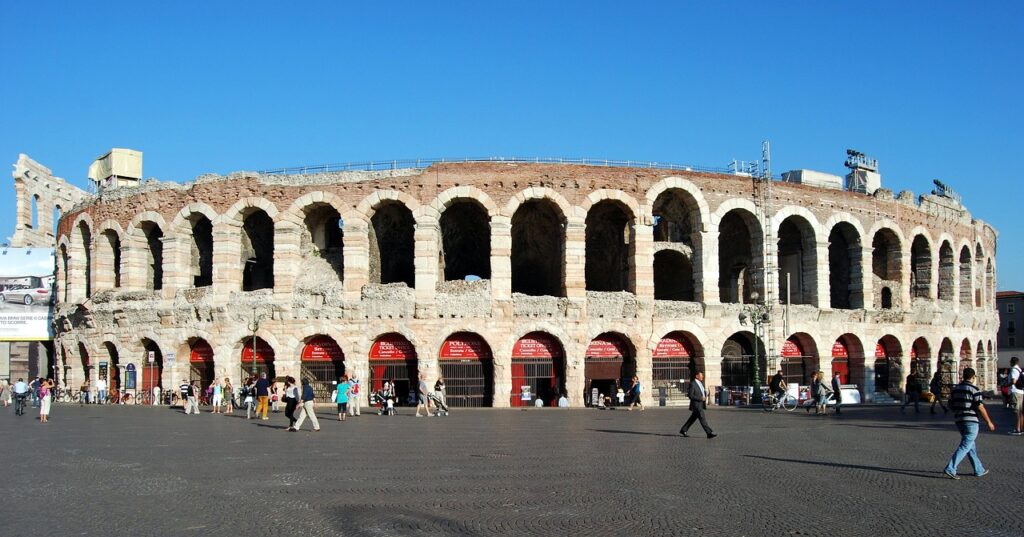
The Arena di Verona is a Roman amphitheatre from the 1st century AD. It is one of the best preserved in Italy and is still used for performances. You can visit it by day without attending an opera. We could not confirm current sightseeing ticket prices, so check the official museum site. Allow about an hour. Piazza Bra, the square in front, is a good place for a first coffee.
From Piazza Bra, walk along Via Mazzini toward Piazza delle Erbe. This is the main shopping street, with international brands and a steady crowd, and it leads you straight to the old Roman forum. Piazza delle Erbe is still the town’s central meeting place, with a daily market, painted house fronts and the Torre dei Lamberti on one side. If you want a view of the roofs and the river bend, climb the tower. Check the entry fee on site, as we could not confirm it.
Nearby, the Scaliger tombs, the Gothic tombs of the medieval ruling family, sit behind an iron fence and can be seen from the street.
Find a hotel for your Italy trip
Flight plus hotel for all Italian regions, searchable by date and budget.
Show Italy offersIs Juliet’s balcony worth visiting?
Only briefly. Juliet is a fictional character, and the house on Via Cappello that tourists visit is a medieval building with a balcony that was added to it in the 20th century to fit the story. It makes a pleasant photo stop and nothing more.
The courtyard is small and very crowded at midday, so go early or late. We could not confirm the entry fee for the house museum, and the interior is the part you can skip if time is short.
Verona leans on the Romeo and Juliet connection in its marketing, but its real appeal is the Roman and medieval city around it.
What should you do on the second day?
Spend day two on the river, the castle and the hill. The walk follows the Adige in a loose loop, and it works well because most of it is outdoors and quieter than day one.
Start at Castelvecchio, a 14th century fortress built for the Scaliger family on the edge of the river. Today it houses the city’s art museum, and the building itself, with its brick towers and its renovation by the architect Carlo Scarpa, is as interesting as the paintings. Allow about two hours. We could not confirm the current entry fee, so check before you go.
Cross the Ponte Scaligero, the fortified bridge attached to the castle, and follow the river toward Ponte Pietra. Ponte Pietra is the Roman stone bridge in the older part of town. It was damaged in the Second World War and rebuilt using the original stones. Stand in the middle for the view along the river.
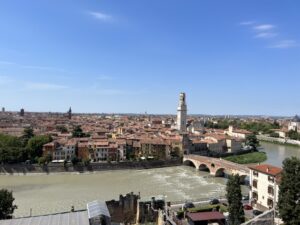
On the far side, climb the steps up the hillside to the Castel San Pietro terrace. You get a wide view of the red roofs, the river bend and the towers you visited the day before. The climb is short but steep. Come in the late afternoon for the best light, then walk back down for your last aperitivo.
If you have time left, the Romanesque Basilica of San Zeno Maggiore and the Renaissance Giardino Giusti are worth a detour. Pick one.
Where do you go for aperitivo and a local meal?
The aperitivo is a fixed part of the evening in Verona. Between about 6 and 8 pm, locals stand in the squares and lanes with a spritz or a glass of regional wine and a plate of small snacks. Piazza delle Erbe and the streets around Piazza dei Signori are the busiest spots, while the lanes toward the river are calmer.
For dinner, order what the region does well. Risotto all’Amarone uses the red wine from the nearby Valpolicella area. Pastissada de caval is a slow cooked horse meat stew from the local tradition, served with polenta. If that does not appeal, look for gnocchi, bollito misto (boiled meats with sauces) or fish from nearby Lake Garda. Wine from Valpolicella, Soave and Bardolino is easy to find by the glass in almost every bar.
We recommend eating one street away from the main squares, because restaurants directly on Piazza delle Erbe and Piazza Bra charge for the position, not for better food.
When is the best time to visit, and what about the opera season?
The best times are spring and early autumn. Temperatures are mild, the squares are pleasant to sit in, and the crowds are lower than in high summer. Winter is quiet and cool.
Summer is opera season. The 2027 Arena festival is scheduled from 12 June, with Aida on opening night, to 11 September, with La Traviata as the final performance. Tickets start at 22 EUR for a numbered seat on the steps. The city is full in these months, so book accommodation and tickets well ahead and keep the evenings free.
FAQ
Is one day enough for Verona?
One day covers the Arena, Piazza delle Erbe, Juliet’s courtyard and a walk across the river, but you will rush. Two days add the castle, the bridge and the hillside terrace at a normal pace.
Is the VeronaCard worth it?
It depends on how many paid sights you visit. The card costs 33 EUR for 24 hours or 38 EUR for 48 hours. Add up the entrance fees of the places on your list, and only buy it if the total is clearly higher.
Can I visit Lake Garda from Verona on the same trip?
Yes, but we would not squeeze it into a two day city visit. If the lake matters to you, add a separate day or an extra night.
Do I need to book the Arena opera in advance?
Yes, especially for weekends and well known titles. The 2027 season runs from 12 June to 11 September, and the cheapest numbered seats on the steps start at 22 EUR. Buy tickets through the official Arena site to avoid resellers.
Is Verona safe for tourists?
It is generally calm and safe. As in any busy tourist town, keep your bag closed in crowded squares and on public transport, and be careful around the Arena after large events.
Plan your Verona weekend
Choose your travel dates first, then book a hotel in or next to the old town so that you can do everything on foot. If you want help combining Verona with other cities in northern Italy, our team arranges trips and train based itineraries through our booking service.
Image credits: Pixabay / pcdazero
 Seychelles with Kids: Beaches, Reserves and Turtles
 A Week on a Yacht: Daily Life, Space, Seasickness and Cost
 Yacht Charter in Malta: What to Know Before You Book
 How to Behave at a Maltese Festa: A Visitor’s Guide