8 min read · Published: August 8, 2024 · Updated: October 29, 2026 · Prices and details checked: October 2026
You can walk through the whole of Malta’s history in five stops, in the order it happened: Neolithic temples at Tarxien, a Roman townhouse in Rabat, the medieval walls of Mdina, the Knights’ city of Valletta and the British forts above the Grand Harbour. Each era left a building you can enter today, and this guide puts them in sequence with entry prices and transport.
Key takeaways
- The route runs in historical order: Tarxien and the Hypogeum (prehistory), Domvs Romana in Rabat (Roman Malta), Mdina (Arab and medieval period), Valletta (Knights of St John), Fort St Elmo (British era), then the parliament for the republic.
- Adult entry at Tarxien Temples, Domvs Romana and St Paul’s Catacombs is 6.00 EUR each. The Hypogeum costs 35.00 EUR and must be booked well ahead.
- St John’s Co-Cathedral in Valletta costs 15.00 EUR for adults, open Monday to Saturday from 09:00 to 16:45, closed Sundays and public holidays.
- A Heritage Malta Multisite Pass costs 60.00 EUR for adults, is valid for 30 days and covers the Grand Master’s Palace and most sites on this route, but not the Hypogeum.
- Every stop is reachable by bus: a single ticket costs 2.00 EUR in winter and 2.50 EUR in summer and is valid for 2 hours including changes.
Table of contents
Where does Malta’s history begin?
Malta’s history begins with the Neolithic temple builders, and the place to meet them is the Tarxien Temples together with the Ħal Saflieni Hypogeum, a short bus ride south of Valletta. The temples are among the oldest free-standing stone buildings in the world, older than Stonehenge and the pyramids of Giza.
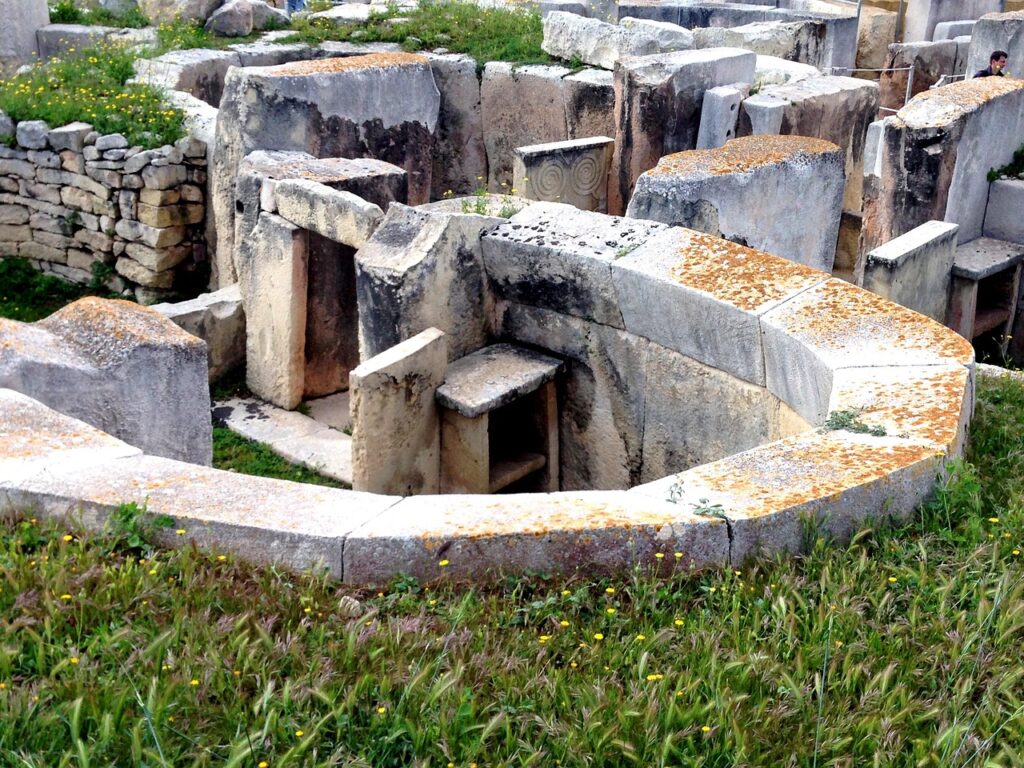
Tarxien is the most richly decorated of the Maltese temple complexes: spiral carvings, animal reliefs and the lower half of a colossal statue, all under a canopy that lets you walk between the chambers. Adult entry is 6.00 EUR, children aged 6 to 11 pay 3.00 EUR and children aged 1 to 5 enter free.
The Hypogeum, a few minutes’ walk away, is an underground burial complex cut into the rock on several levels. Only 10 people are admitted at a time for conservation reasons, adult tickets cost 35.00 EUR and Heritage Malta strongly recommends booking early on its official site. Children aged 1 to 5 are not admitted. A few last-minute tickets go on sale the day before, at most 4 per person.
What did the Phoenicians and Romans leave behind?
The Phoenicians put Malta on the trade routes and most likely gave it its name; the Romans made the hilltop town of Melite, today’s Mdina and Rabat, the island’s capital. The site for this era is the Domvs Romana on the edge of Rabat, just outside the Mdina walls.
The Domvs Romana was a wealthy townhouse, and its mosaic floors are the reason to go; the museum around them explains Malta’s place in the Carthaginian and Roman Mediterranean. Adult entry is 6.00 EUR, children aged 6 to 11 pay 3.00 EUR.
A short walk into Rabat brings you to St Paul’s Catacombs, an underground cemetery from late Roman and Byzantine times and the oldest physical evidence of Christianity on the islands, which tradition traces to St Paul’s shipwreck here. Entry is 6.00 EUR for adults, 3.50 EUR for children aged 6 to 11. Both sites are included in the Multisite Pass.

Combine your trip with a hotel in Malta
Flight plus hotel in Sliema, St. Julian's or Gozo for your dates and budget.
Show Malta offersWhy does Mdina stand for the Arab and medieval centuries?
Mdina carries the Arab period in its name and its street plan. The Arabs who ruled after the Byzantines shrank the Roman town to its defensible core and named it Mdina, from the Arabic word for a walled city; the Maltese language, with its Semitic grammar, is the most lasting legacy of this era.
Walking Mdina costs nothing and is the best way to read it: the bending lanes were laid out so that no attacker could see far ahead, and after the Normans took the islands from Sicily the town became the seat of the Maltese nobility, whose palaces still carry their family names. For a street-by-street walk, see our guide to Mdina, a journey through time.
How did the Knights of St John shape Valletta?
The Knights of St John built Valletta from nothing after surviving the Great Siege by the Ottoman Empire, and the city is still their monument: a grid of streets on a fortified peninsula, planned in the sixteenth century and today a UNESCO World Heritage Site. This is the longest stop on the route and deserves a full day.
Start at St John’s Co-Cathedral, the Knights’ conventual church. The plain facade hides a Baroque interior in which each langue of the Order decorated its own chapel, the floor is paved with inlaid marble tombstones of knights, and the oratory holds Caravaggio’s Beheading of St John the Baptist. Adult entry is 15.00 EUR, students and seniors pay 12.00 EUR, children under 12 enter free with an adult. Hours are Monday to Saturday 09:00 to 16:45, closed Sundays and public holidays. Our article on St John’s Co-Cathedral covers the chapels in detail.
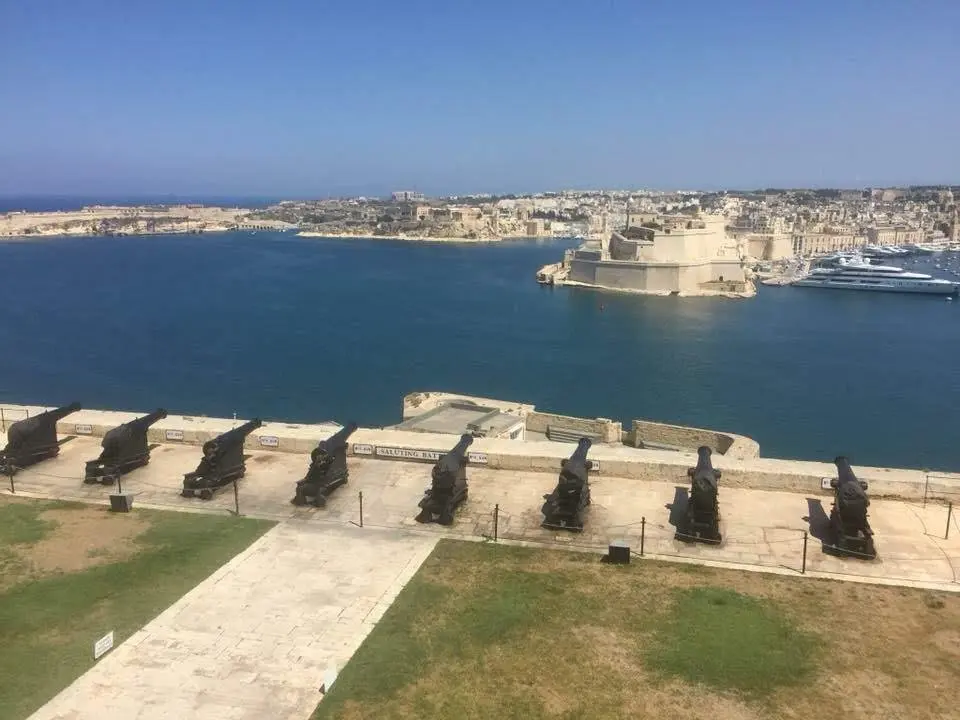
Walk on to the Grand Master’s Palace on Republic Street, seat of the Order’s rulers and later of the British governors, covered by the Multisite Pass. Finish at the Upper Barrakka Gardens for the view across the Grand Harbour to the Three Cities, where the Knights first settled and the Great Siege was fought. The Barrakka lift to the waterfront costs 1.00 EUR return and is free for harbour ferry ticket holders; the ferry to Cospicua runs every 30 minutes, and in Birgu the Inquisitor’s Palace and Fort St Angelo complete the Knights’ story.
Our tip: Take the ferry across to Cospicua and walk on to the Gardjola Gardens at the tip of Senglea. The gardens are free to enter, and the little guard turret there, carved with an eye and an ear, looks out over the Grand Harbour. Fort St Angelo in Birgu, which is open to visitors, is the other great viewpoint on the same walk.
What remains of the British era?
The British ran Malta as a naval base, and their legacy is everywhere: English as an official language, driving on the left, red letter boxes, and the dockyards around the Grand Harbour. The site to visit is Fort St Elmo at the tip of Valletta, home to the National War Museum run by Heritage Malta.
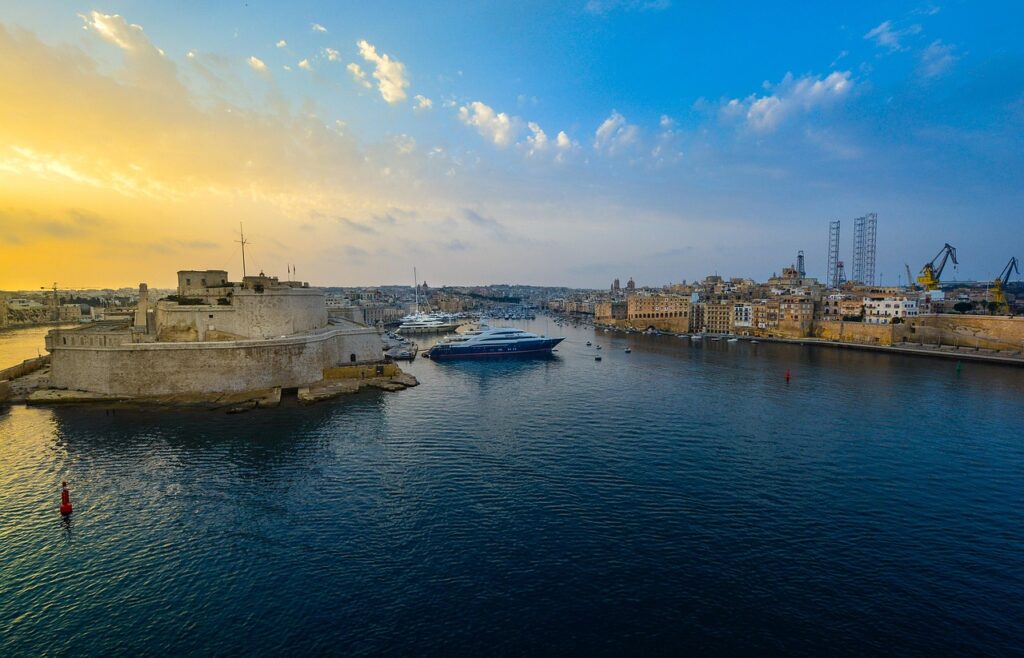
The fort itself dates from the Knights, but the museum tells the island’s story through to the Second World War, when Malta endured one of the heaviest bombing campaigns of the conflict and was awarded the George Cross, still shown on the national flag. Below the Upper Barrakka Gardens, the Saluting Battery still fires a ceremonial gun as it did under the British, and the Lascaris War Rooms beneath the bastions were the wartime headquarters.
Where does the route end?
The route ends at Valletta’s city gate, where the stone parliament by Renzo Piano stands for the independent republic. Malta gained independence from Britain in the mid twentieth century, became a republic a decade later and has since joined the European Union and the euro area, so the newest layer of its history is political rather than architectural. At the gate the Knights’ bastions, the ruins of the British era Royal Opera House and the modern parliament stand side by side.
How do you plan the route in practice?
Allow three days, split by geography: one for Tarxien and the Hypogeum with an afternoon in the Three Cities, one for Rabat and Mdina, and a full day for Valletta with Fort St Elmo. All stops are on bus routes from Valletta, and a single ticket is valid for 2 hours including changes.
The Multisite Pass pays off if you enter Tarxien, Domvs Romana, St Paul’s Catacombs, the Grand Master’s Palace and Fort St Elmo: 60.00 EUR for adults, 45.00 EUR for seniors and students, 30.00 EUR for children, valid 30 days from first use. The Hypogeum and St John’s are paid separately. Heritage Malta sites stop admitting visitors 30 minutes before closing and are closed on 1 January, Good Friday and 24, 25 and 31 December.
FAQ
Is the Hypogeum worth 35.00 EUR?
For anyone interested in prehistory, yes. It is the only known underground temple complex of its age, and the small group size means you see it in near silence. If the price or the booking lead time rules it out, Tarxien, or Ġgantija on Gozo, shows you the same temple culture above ground for a fraction of the cost.
Can you do this history route without a car?
Yes. Every stop is served by buses from Valletta, and the Three Cities and Sliema are also linked to Valletta by harbour ferry. A car is a disadvantage in Valletta and Mdina, where parking is scarce and the old centres are closed to most traffic.
Are the historic sites suitable for children?
Mostly yes. Heritage Malta admits children aged 1 to 5 free and charges a reduced rate from age 6, and St John’s Co-Cathedral is free for children under 12 with an adult. The exception is the Hypogeum, which does not admit children aged 1 to 5.
Do you need to dress differently for any stop?
Only for St John’s Co-Cathedral, which is a working church: cover shoulders and knees, bring a scarf if unsure, and do not wear stiletto or narrow heels, which are not allowed on the marble floor. The temples and forts have no dress code, but most are open-air and uneven underfoot, so bring sun protection and sturdy shoes.
Book your Hypogeum slot first, then build the other days around it. From Sliema or St Julian’s every stop is a bus or ferry ride away, and our holiday apartments in Sliema and St Julian’s make a practical base for a stay built around Malta’s history.
Image credits: Pixabay / Efraimstochter; Travelissimo; Pixabay / foursummers; Pixabay / user32212
Sources (13)
Prices, times and rules in this article come from these sources. Last checked: October 29, 2026.
- stjohnscocathedral.com / visit
- heritagemalta.mt / store/c95
- heritagemalta.mt / explore/hal-saflieni-hypogeum
- publictransport.com.mt / en/fares
- heritagemalta.mt / explore/tarxien-temples
- heritagemalta.mt / opening-hours
- transport.gov.mt / maritime/ports-commercial/barrakka-lift-826
- heritagemalta.mt / explore/st-pauls-catacombs
- heritagemalta.mt / explore/domvs-romana
- visitmalta.com / en/a/gardens
- assets.atlasobscura.com / places/il-gardjola-guard-tower
- heritagemalta.mt / explore/fort-st-angelo
- vallettaferryservices.com
 Holiday Apartment or Hotel? How to Choose and Book Well
 Best Beaches in Europe 2027: Eight Beaches and How We Chose Them
 Most Popular Cities in Europe 2027 and When to Go
 Summer Holidays 2027: When to Book and Where to Go