8 min read · Published: December 27, 2024 · Updated: October 29, 2026 · Prices and details checked: October 2026
The best months for a Seychelles trip are April, May and October, when winds are light and the seas are calm enough for boat crossings. Most of what makes or breaks a trip is decided before you leave: the season you pick, how many islands you try to fit in, and how you move between them. For beaches and places, see our guides to family holidays in the Seychelles and lesser-known islands.
Key takeaways
- The Northwest Monsoon runs from December to March, the Southeast Monsoon from May to October, with April, October and November as the shorter transition months.
- January is the wettest month. October has the most dry days (16, according to the national weather service).
- Cat Cocos ferries take 1 hour 15 minutes from Mahé to Praslin and 15 minutes from Praslin to La Digue.
- Air Seychelles allows 15 kg checked and 5 kg hand baggage on Mahé to Praslin flights, so pack light.
- Every visitor needs a travel authorisation before arrival. The official fee is €10 per application, applied for only on the government site.
Table of contents
When is the best time to visit the Seychelles?
April, May, October and the start of November give you the calmest conditions for moving between islands. These are the months when one monsoon hands over to the other and the wind drops.
| Period | Conditions |
|---|---|
| December to March | Northwest Monsoon: light to moderate winds and the rainy season; January is the wettest month |
| April | End of the rains, light and variable winds |
| May to September | Southeast Trades: stronger winds, peaking in July and August with rough seas; showers light and short |
| October | Highest number of dry days (16); winds weaken considerably |
| November | The rains set in again |
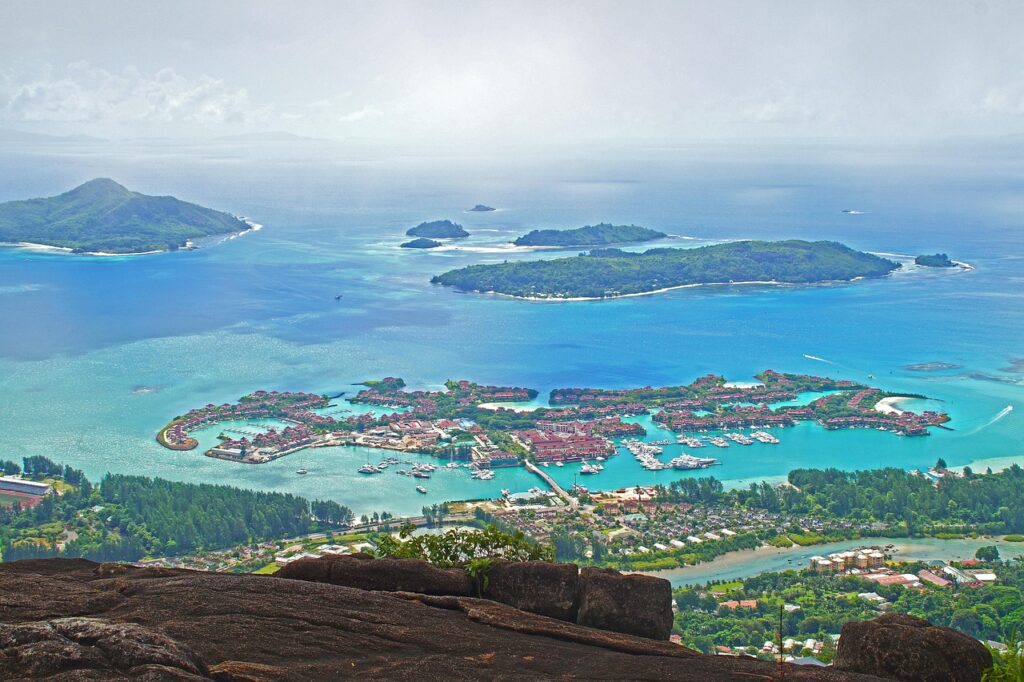
The national weather service describes the year in three parts. From December to March the Northwest Monsoon brings light to moderate winds and the rainy season, with January the wettest month. From May to September the Southeast Trades set in and winds strengthen, peaking in July and August with rough seas, although showers are light and short. April is the end of the rains with light, variable winds. October has the highest number of dry days (16), and winds weaken considerably. In November the rains set in again.
If you plan to cross between islands by boat, avoid July and August unless you are comfortable with rough water. If you want the driest, coolest weather and do not mind wind, July is your month. If you want to swim in sheltered bays on calm days, aim for April, May or October.
How much should you budget for the Seychelles?
Plan the budget around accommodation type and the number of islands, not around meals. Your costs depend far more on where you sleep and how often you move than on what you eat.
Three decisions drive the price:
- Accommodation type: Guesthouses and self-catering apartments cost noticeably less than resorts, and a kitchen lets you cook some meals. Resort stays make sense if you want a single island and all services in one place.
- Number of moves: Every island change means a ferry or flight, plus luggage handling and a night’s accommodation. Two islands in ten days costs far less than four.
- Eating locally: Small local eateries are usually the lower-cost option, and resort dining the higher. Check menu prices before sitting down rather than after.
We do not quote nightly rates because they swing widely by season and island. Ask for the total price including transfers before you compare offers, since a cheap room on a remote island can cost more once the boat or flight is added.
Combine these islands with a hotel stay
Flight plus hotel on Mahé, Praslin and La Digue for your dates.
Show Seychelles offersHow does island hopping work between Mahé, Praslin and La Digue?
Take the Cat Cocos catamaran for the main three islands and use Air Seychelles only where speed matters. The ferry connects Mahé, Praslin and La Digue, and the operator states there are multiple trips every day of the week.
Crossing times from the operator’s schedule page:
- Mahé to Praslin: 1 hour 15 minutes
- Praslin to La Digue: 15 minutes
- Mahé to La Digue direct: 1 hour 10 minutes
- Mahé to La Digue via Praslin: 1 hour 45 minutes
Some departures stop at the Praslin jetty at Baie Sainte Anne, so check whether your sailing is direct. Book through the operator’s online booking service and look at the current timetable before fixing your hotel dates, because the timetable changes by period.
Air Seychelles also flies between Mahé and Praslin. It is the better choice if you are prone to seasickness or travelling in the rough months of July and August. Note the luggage rules, covered in the next section.
A practical sequence is to start on Mahé after your international flight, move to Praslin, then take the short hop to La Digue. For a stay of a week or less, we suggest two islands, not three. Each transfer eats half a day once you count packing, check-out, the crossing and check-in.
What should you pack for the Seychelles?
Pack light, because the domestic flight has a strict weight limit and the islands reward a small bag. Under the policy published by Air Seychelles, adults on Mahé to Praslin flights get 15 kg of checked baggage and 5 kg of hand baggage. Heavier bags cost extra per kilogram or travel as cargo, and the airline does not guarantee that bags travel on the same flight. Confirm the current rules with the airline before you fly.
Hand baggage must be a handbag, laptop bag, slim backpack or briefcase, within 55 cm by 40 cm by 20 cm. Reusable shopping bags, printed plastic bags and oversized open tote bags are not accepted as hand or checked baggage on any flight. Check the size and type of your bag, not just the weight.
What to bring:
- Swimwear, light clothing and a light layer for evenings, especially in the Southeast Monsoon, when the national weather service notes that July nights can feel chilly.
- Reef-safe sun protection and a hat.
- Water shoes for rocky entries.
- A reusable water bottle and a dry bag for boat days.
Leave behind plastic straws and anything balloon-related. Customs regulations list plastic straws and balloons among prohibited imports, and plastic bags and plastic utensils among restricted ones.
What do you need before you arrive?
You need a valid passport, a travel authorisation, proof of onward travel and proof of accommodation. This is based on the UK government’s entry guidance for British citizens, so check the rules for your own nationality.
The key points from that guidance:
- No visa is needed for British citizens, but a travel authorisation must be obtained online before travel.
- You should be able to show a return or onward ticket, confirmed accommodation and sufficient funds.
- The visitor’s permit on arrival is for 3 months and is free.
- Cash of 50,000 Seychellois rupees or more must be declared.
The Seychelles tourism department states that the standard fee for the travel authorisation is €10 per application, and that you should apply only through the official government system at govtas.com. Third-party sites charge significantly more, and travellers who used them reported problems at embarkation. Apply early, since the UK guidance mentions applications can be made up to 30 days before arrival.
How should you behave on the islands?
Treat the islands as protected places: stay on paths, do not take natural souvenirs and follow site rules. Wildlife and reefs are the main draw, so protect both.
- Shells and corals: These are listed as restricted goods in the customs regulations, so leave them where they are.
- Marine life: Do not stand on coral or feed fish.
- Nature sites: Entrance fees at sites run by the Seychelles Islands Foundation changed in 2023, and booking online gives a 10% discount. Check the current fee on the operator’s site before you go.
- Dress: Cover shoulders and knees when entering churches and other religious places, and put on a shirt away from the beach.
- Plastic: Avoid single-use plastic. The country restricts or prohibits several plastic items at the border.
FAQ
Do you need a visa for the Seychelles?
Many nationalities, including British citizens, do not need a visa but must obtain a travel authorisation online before arrival. The visitor’s permit on arrival is for 3 months. Check the entry rules for your own passport on the official government site.
Can you island hop in July and August?
It is possible, but the Southeast Trades peak in those months and the national weather service reports rough seas. If you are sensitive to motion, book the Air Seychelles flight between Mahé and Praslin and choose accommodation close to the ferry or airstrip on La Digue.
Can you do the Seychelles on a budget?
Yes, with guesthouses or self-catering apartments, local eateries and fewer island changes. Do not choose the cheapest room without checking transfers, since a cheap bed far from a ferry port can cost more in transport.
How many islands should you visit in a week?
Two. Mahé plus one of Praslin or La Digue lets you enjoy each stay. A third island adds another transfer day, which is rarely worth it in seven nights.
Is tap water safe to drink?
Local conditions vary by island and accommodation, so ask your host before drinking from the tap. A reusable bottle that you refill from the water your accommodation recommends keeps plastic waste down.
If you want help sequencing islands, flights and ferries into one trip, send us your dates through our booking service and we will build the itinerary with you.
Image credits: Pixabay / Penstones; Pexels; Pixabay / SCAPIN; Pixabay / jean52Photosstock
Sources (1)
Prices, times and rules in this article come from these sources. Last checked: October 29, 2026.
 Italy Train Travel: Routes, Tickets and Saver Fares
 Garden Route Itinerary: Stages for Seven to Ten Days
 Train or Plane in Europe: Time, Cost and Comfort Compared
 Where to Stay in Mallorca for a Retreat, and When to Go