6 min read · Published: July 25, 2023 · Updated: October 29, 2026 · Prices and details checked: October 2026
St John’s Co-Cathedral in Valletta is open Monday to Saturday from 09:00 to 16:45, costs 15 EUR for adults and is closed on Sundays. Behind a plain stone front hides one of the most richly decorated church interiors in Europe, with a floor of inlaid marble tombstones and two paintings by Caravaggio. This guide covers what you pay, what to wear, what to look at and how to avoid the common mistakes.
Key takeaways
- Adult entry is 15 EUR, students and seniors pay 12 EUR, and children under 12 enter free with an adult.
- Opening hours are Monday to Saturday, 09:00 to 16:45. The cathedral is closed on Sundays and on public holidays.
- Shoulders and knees should be covered, and stilettos and narrow heels are not allowed.
- Caravaggio’s “The Beheading of Saint John the Baptist” hangs in the Oratory and is the main reason most visitors come.
- The Belfry Tour costs 5 EUR extra, and a visit takes about an hour if you look properly.
Table of contents
How much does it cost and when is it open?
Adults pay 15 EUR. Students and seniors pay 12 EUR, and children under 12 enter for free when accompanied by an adult. The Belfry Tour, which takes you up into the bell tower, is a 5 EUR supplement.
The cathedral opens Monday to Saturday from 09:00 to 16:45. It is closed on Sundays and public holidays, because it remains a working church. The official website gives slightly different times for the last admission (16:00 on one page, 16:15 on another), so do not arrive at the end of the afternoon. Mid morning or after 14:00 is usually calmer than the middle of the day, when tour groups arrive together.
Check the official site at stjohnscocathedral.com before you go, since the cathedral can close for services and events.
What should you wear?
Dress as you would for any church. Cover your shoulders and knees, and bring a scarf or light cover-up if you are visiting in summer, when most people walk around in shorts and vests. Stilettos and other narrow heels are not allowed, because they damage the marble floor.
This is a practical rule as much as a courtesy. The floor is made of memorial slabs, and the building is still used for worship. If you are travelling in July or August, plan your clothes before you reach the door instead of hoping to sort it out at the entrance.
Combine your trip with a hotel in Malta
Flight plus hotel in Sliema, St. Julian's or Gozo for your dates and budget.
Show Malta offersWhat does the outside look like?
The exterior is plain and almost fortress like, with two bell towers and a simple façade facing St John’s Square. It was designed for a military religious order, not for show, and nothing outside prepares you for the interior.
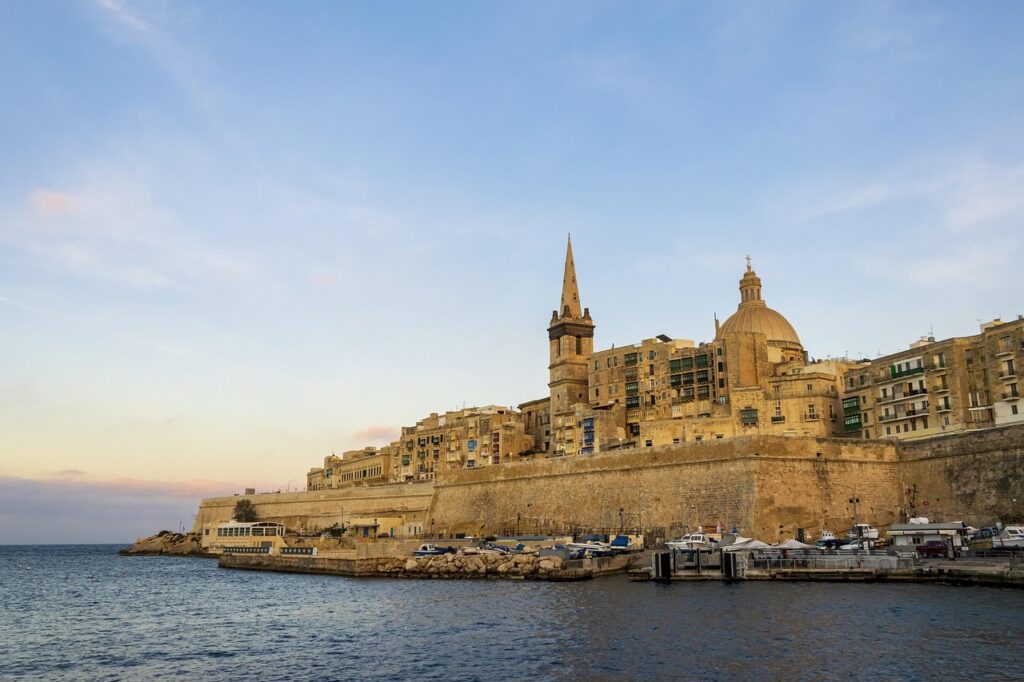
The church was built for the Order of St John in the 1570s to designs by the Maltese architect Girolamo Cassar. It was given the status of co-cathedral in 1816, which is why it carries that name today. Take a minute in the square before you go in, because the contrast between the sober outside and the gilded inside is part of the experience.
What is inside the cathedral?
The first thing most people notice is the floor, which is covered with hundreds of inlaid marble tombstones of knights. Each slab shows coats of arms, skulls, banners and allegories in coloured stone. Please walk on the marked route and read the slabs slowly: this is one of the few places where you look down first and up second.
Then look up. The barrel vault is painted with scenes from the life of St John the Baptist by Mattia Preti, a Calabrian artist and knight who worked on the church in the 17th century. The walls and the pillars are carved with gilded ornament so densely that there is hardly a plain surface in the nave.
Along both sides of the nave you find chapels, one for each of the langues, the national groups into which the knights were divided. Each langue decorated its own chapel with altarpieces, sculpture and the tombs of its members, so you can compare the styles of Italy, France, Spain and Germany within a few metres of each other.
Where is the Caravaggio painting, and is it worth the queue?
“The Beheading of Saint John the Baptist” hangs in the Oratory, a side room off the nave, and yes, it is worth seeing. It is the largest painting Caravaggio ever made and the only one he signed, painted while he was living in Malta as a member of the Order.
Nearby in the Oratory hangs his “Saint Jerome Writing”. Both pictures are lit in a quiet room, and the dark background and tight focus on the figures are what make them different from the gold of the nave. Give them a few minutes without a camera in your hand. If the room is crowded, visit the chapels first and return to the Oratory later.
Where are the Grand Masters buried?
Below the church is a crypt that contains the tombs of several Grand Masters, among them Jean de Valette, who led the defence of Malta in the Great Siege of 1565 and founded the city that carries his name. Other Grand Masters are commemorated by monuments inside the chapels above.
You do not need to know the history of the Order to enjoy the visit, but the names on the tombs make more sense after a short read about the Great Siege. The Order itself ruled Malta from 1530 to 1798. For the wider story of the city, see our guide to Valletta.
How long should you plan, and what else is nearby?
Plan about an hour inside, longer if you add the Belfry Tour or read the information panels. The cathedral is in the centre of Valletta, so it fits easily into a morning before lunch.
The Grand Master’s Palace is a short walk away and covers the political side of the Order, with its state rooms and armoury. We describe it in the guide to the Grandmaster’s Palace. Combining the two on the same day works well, but do not squeeze in a third indoor sight, because the interior of the cathedral takes more concentration than it first seems.
FAQ
Is St John’s Co-Cathedral open on Sundays?
No. It is closed on Sundays and public holidays and opens Monday to Saturday from 09:00 to 16:45. If you only have a short stay in Valletta, plan the cathedral for a weekday or a Saturday morning.
Can you take photos inside?
Check the signs and the instructions from staff when you enter, as rules on photography and flash can change. Even where photos are allowed, flash and tripods are a poor idea in a historic church with fragile paintings. Look first and take pictures later.
Do children need a ticket?
Children under 12 enter free when accompanied by an adult. Older children pay the student or the adult price, depending on whether they can show student identification.
Is the Belfry Tour worth the extra 5 EUR?
It is worth it if you enjoy views over Valletta’s rooftops and the harbour, and if you do not mind climbing. If you only have time for the main interior, skip it and spend the time in the Oratory instead.
Do you need to book in advance?
The official website is the place to check current ticket options and any closures for religious services. If you travel in a group, confirm your visit there before you go.
If you want to see Valletta on foot and then return to a comfortable base, our own holiday apartments in Sliema and St. Julian’s are a short ferry or bus ride from the city: see the holiday apartments in Malta.
Image credits: Mike Nahlii, Unsplash; Pixabay / db_oblikovanje; Pixabay / Experiances
 Seychelles with Kids: Beaches, Reserves and Turtles
 A Week on a Yacht: Daily Life, Space, Seasickness and Cost
 Things to Do in Pretoria: A Day Trip Plan from Johannesburg
 Sicilian Cuisine: What to Eat, Drink and Order in Sicily